How to Test Merch Ideas Before You Launch
Use this practical 7-day merch test to compare three designs, track clicks and orders, check real margin, and decide what is worth launching.
Direct Answer
The short version
The simplest useful merch test is **one audience, three original designs, one product, one price, and one sales channel**. Run the test for seven days. Use the first two days to research the audience and prepare the designs, the next three days to compare content and product-page clicks, and the final two days to accept real orders and check the margin. Do not expand a product because it received likes. Continue only when people click through, accept the price and shipping terms, and place orders that leave a workable contribution margin.The 7-Day Merch Test at a Glance
| Day | What you do | What you need to learn | |---|---|---| | 1 | Choose one audience and collect real examples of what they respond to | Which subjects, phrases, occasions, and visual styles repeat | | 2 | Turn the research into three clearly different designs | Whether each idea gives the audience a specific reason to buy | | 3 | Put all three designs on the same product | Whether the test is fair and the mockups look trustworthy | | 4–5 | Publish comparable content and send traffic to product pages | Which design earns relevant clicks and buying questions | | 6–7 | Make the strongest option orderable | Whether people accept the full offer and the numbers work |
At the end of day seven, choose one of four actions: stop it, revise the design, revise the offer, or continue with a larger test.
Day 1: Choose the Audience Before the Product
Start by deciding who the product is for. “People who like mugs” is not an audience. “Nursing students buying small gifts for classmates” is specific enough to research.
Spend 45–60 minutes collecting evidence. You are looking for repeated subjects, jokes, colors, occasions, frustrations, and gift reasons.
Check:
Start with your own audience if you already have one. Comments, direct messages, saved posts, email replies, site searches, and past product clicks are more useful than a general trend report because these are the people you can reach.
Then check the wider market:
- Google Trends for seasonality and regional interest
- TikTok Creative Center for current visual formats and audience language
- Etsy, Amazon, TikTok Shop, or Google autocomplete for the phrases shoppers use
- Reviews on comparable products for common complaints and gift occasions
- Pinterest or Instagram saves for visual styles that keep appearing
Collect about 20 useful examples. Do not copy another seller’s artwork or use protected characters, logos, lyrics, or slogans. You are looking for a pattern, not a design to steal.
What you should have by the end of day one: one audience, one buying occasion, and a short list of visual directions.
Day 2: Turn the Research Into Three Designs
Make three designs that are meaningfully different. Changing a background from blue to green does not create a new test.
For a study-focused audience, the three directions might be:
- Late-night study humor
- Calm exam-season encouragement
- Organized desk and stationery patterns
Each direction should answer a simple question: why would this person use it, gift it, or show it?
Use Figma, Canva, Adobe Express, or the design tool your team already knows. Keep the artwork original and check that text remains readable at product size. If the design depends on tiny details that disappear on a phone case or mug, fix it now rather than after the sample arrives.
What you should have by the end of day two: three production-ready artwork files and a one-sentence reason to buy each one.
Day 3: Put Every Design on the Same Product
Choose one product that fits all three designs. Do not test a mug, phone case, and wall art print against one another in the first round. You would not know whether the winner came from the artwork or the product.
Keep these variables identical:
- Product
- Selling price
- Mockup angle and lighting
- Product title structure
- Shipping message
- Sales channel
- Call to action
For example, place all three study designs on the same white mug at the same price. Use one clean front-view mockup and one lifestyle image for each.
The PODJST product catalog can help you compare available formats. Phone cases work well for repeat patterns and bold vertical designs. Custom mugs are useful for gifts, short messages, and designs that wrap around a wider surface.
Before publishing, check the print area, edge coverage, camera openings, handle placement, and text size. Order a sample when color, fit, or presentation could materially affect the offer.
What you should have by the end of day three: three comparable product pages or draft listings that differ mainly in artwork.
Days 4–5: Test the Content and the Click
Publish one piece of content for each design under similar conditions. The format can be a short video, carousel, email, community post, or creator channel post.
Use three practical content angles:
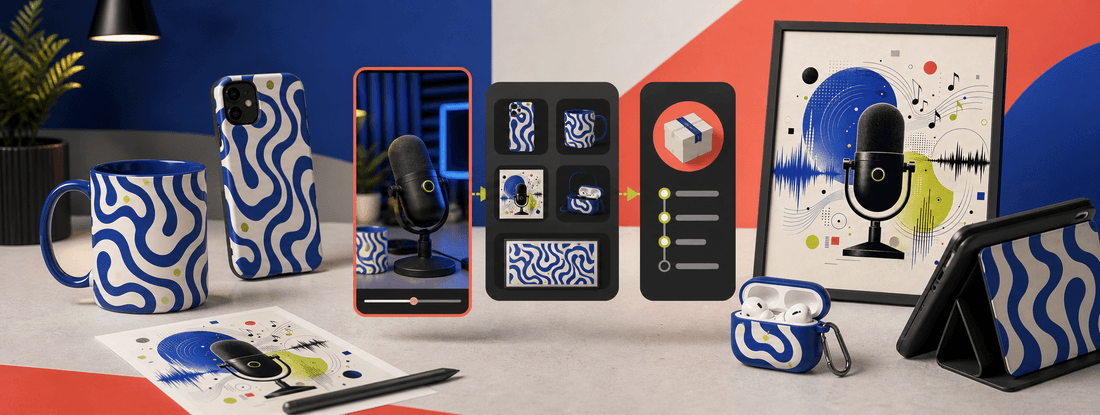
- Design reveal: show the artwork becoming a physical product
- Use case: show the product on a desk, in a room, or being used
- Gift angle: show who the product is for and when someone would give it
Do not ask only, “Which design do you like?” Ask, “Which one would you actually use or give as a gift?” The second question is still not proof of demand, but it is closer to a buying decision.
Give every concept its own tagged link. Record:
- Relevant views or impressions
- Product-page clicks
- Saves and shares
- Add-to-cart events
- Buying questions in comments or messages
Do not use another seller’s universal CTR or conversion benchmark. Compare your three designs against one another under the same account, audience, channel, and period.
If none of the posts receives enough relevant traffic to compare, the test is incomplete. Change the opening hook or distribution before changing the product.
What you should know by the end of day five: which design makes the right people leave the feed and inspect the offer.
Days 6–7: Test a Real Offer
Take the strongest one or two designs and make them orderable. The product page must show the real price, product details, expected production and delivery information, and a clear checkout path.
If you already have organic traffic, send the offer to that audience first. If you need paid traffic, set a test budget you are comfortable losing and use the same audience and placement for each surviving design. The goal is not to force sales. It is to find out whether the offer works when a buyer sees the full cost and shipping terms.
Track:
- Product-page sessions
- Add-to-cart events
- Checkout starts
- Paid orders
- Selling price
- Product and shipping cost
- Platform and payment fees
- Ad spend
- Questions, cancellations, and refund reasons
Print on demand lets you accept orders without buying bulk inventory upfront, but it does not make a losing offer profitable. Review product and route costs through the PODJST pricing page and confirm the eligible custom merch workflow before increasing traffic.
What you should know by the end of day seven: whether to stop, change the creative, change the offer, or continue.
Diagnose the Result Before You Change Anything
The point of the test is not to “find a winner.” It is to identify where the offer breaks.
| What happened | Most likely issue | What to test next | |---|---|---| | Low relevant views | Weak hook or poor distribution | Rewrite the first seconds, thumbnail, or opening line | | Views but few product clicks | Artwork or message is not creating buying interest | Change the design direction or product angle | | Clicks but few add-to-cart events | Product, price, mockups, or page trust is weak | Improve the offer before buying more traffic | | Add to cart but no checkout | Shipping cost, delivery expectation, or checkout friction | Make total cost and delivery information clearer | | Orders but little or no margin | The economics do not work | Raise the price, reduce variable cost, or stop | | Orders with healthy margin and manageable support | The test has earned a larger round | Increase traffic gradually and test a second product |
Change one major variable at a time. If you change the artwork, price, product, audience, and video together, you lose the lesson from the first test.
Use a Simple Test Sheet
A spreadsheet is enough. Create one row for each design and record:
| Design | Audience | Product | Price | Views | Product clicks | Add to carts | Orders | Revenue | Variable cost | Decision | |---|---|---|---:|---:|---:|---:|---:|---:|---:|---| | Theme A | Study audience | Mug | — | — | — | — | — | — | — | Stop / revise / continue | | Theme B | Study audience | Mug | — | — | — | — | — | — | — | Stop / revise / continue | | Theme C | Study audience | Mug | — | — | — | — | — | — | — | Stop / revise / continue |
Calculate contribution per order:
> Selling price − product cost − shipping − platform/payment fees − discounts − ad cost per order − replacement allowance
This is not a full profit-and-loss statement, but it quickly exposes a product that can generate orders while still losing money.
Decide: Stop, Revise, or Continue
Stop
Stop when the design receives fair exposure but the right audience still ignores it, or when the price required for a workable margin is unrealistic.
Revise the design or content
Revise when the audience responds to the subject but does not click the product. Try a stronger visual, clearer message, better opening hook, or a product that fits the artwork more naturally.
Revise the offer
Revise when people click but do not add to cart. Check the price, mockups, product description, variants, shipping cost, and delivery message.
Continue
Continue when the product receives paid orders, leaves a workable contribution margin, and does not create excessive quality or support problems. Increase traffic in steps. Do not add five new products on the same day.
A Short Example
A study creator tests three mug designs: a late-night joke, an exam encouragement message, and a desk-organization pattern.
The joke gets the most video views. The desk pattern gets fewer views but more product clicks and the first paid orders. The result is straightforward: the joke is better content, while the desk pattern is the stronger product.
The next test keeps the desk pattern and price unchanged, then applies it to one phone case. That is a useful follow-up because only the product format changes.
Five Mistakes That Ruin a Merch Test
- Testing several products at once. You cannot tell whether buyers preferred the design or the product.
- Using better mockups for one option. Presentation quality becomes the variable.
- Treating likes as orders. A person can enjoy a post without wanting the product.
- Ignoring shipping and fees. Revenue is not contribution margin.
- Continuing because the artwork took time. Time already spent is not evidence of demand.
Next Step
Choose one audience today. Collect 20 examples, turn them into three original designs, and put all three on the same product. By the end of the week, you should have a written decision based on clicks, carts, orders, and contribution margin rather than opinions.
Browse merch ideas for small creators, explore creator merch workflows, or start with the lessons in POD University.
FAQ
Common questions
How can I test a merch idea without buying inventory?
Create comparable mockups, send traffic to real product pages, and make the strongest design available through an eligible print-on-demand product. This lets you collect click, checkout, and order evidence without purchasing bulk stock first.
How many merch ideas should I test at once?
Three themes on one hero product is a practical starting point. It creates enough contrast to learn something without introducing so many variables that the result becomes difficult to interpret.
Are social media polls useful for merch testing?
Yes, but only as a concept signal. Polls can help compare creative directions. They do not test price, shipping, checkout, or willingness to pay, so follow them with a click test and a real offer.
What is the strongest signal that a merch idea works?
A paid order at a workable contribution margin is stronger than a like, save, poll vote, or product-page visit. Repeat orders and manageable post-purchase support make the evidence stronger still.
Should I use preorders or print on demand?
Use preorders only when the product, timing, cancellation terms, and fulfillment plan are clear. Print on demand is often easier for ongoing tests because eligible products can be produced after orders are placed, reducing the need for bulk inventory.
How long should a merch test run?
Seven days is enough for a focused first pass when you already have relevant traffic. If the designs did not receive enough comparable exposure, extend the traffic test instead of pretending the result is conclusive.