Multi-Country Print-on-Demand: When Local Production Pays Off
See how PODJST uses local production in the USA, Canada, Germany, and Spain, plus China fulfillment, to balance delivery, cost, and catalog depth.
Direct Answer
The short version
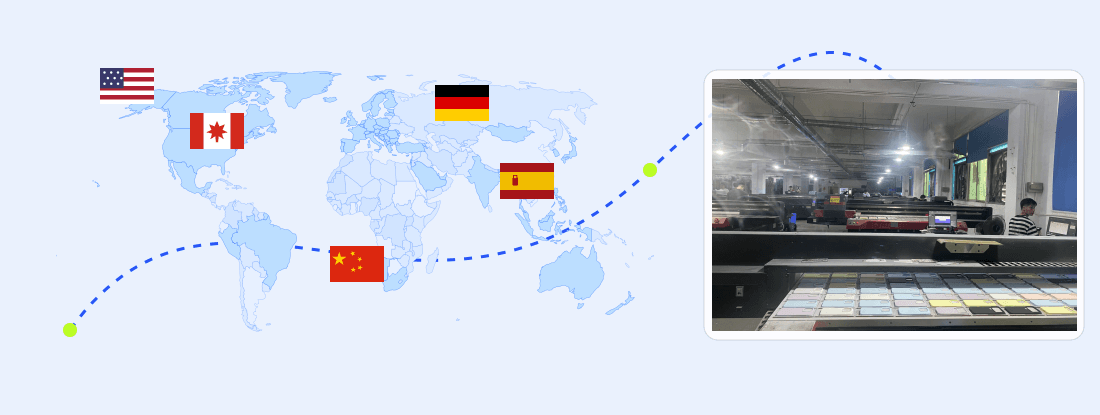
Multi-country print-on-demand gives a seller more than one way to fulfill an order. PODJST supports local production routes in the USA, Canada, Germany, and Spain for eligible products, with typical local delivery estimates of 1–4 business days. When a product is not available on a local route, China offers the broadest product selection in the PODJST network and can ship many cross-border orders by air with an estimated 5–8-day delivery window. The best route is not always the closest one. It is the route that balances product availability, landed cost, delivery expectations, quality control, and the risk of customer-service problems.What PODJST's Multi-Country Production Network Looks Like
PODJST uses a mixed production network rather than forcing every order through one country. Local routes are useful for products with established regional production, while China remains important for catalog depth and products that are not yet supported locally.
| Production route | Best use | Current delivery estimate | Main trade-off | | --- | --- | --- | --- | | USA local production | Eligible products sold to US buyers | 1–4 business days | Local product selection is smaller than the China catalog | | Canada local production | Eligible products sold to Canadian buyers | 1–4 business days | Availability depends on the exact product | | Germany local production | Eligible products sold to German and supported European buyers | 1–4 business days | Not every design, material, or SKU is available locally | | Spain local production | Eligible products sold to Spanish and supported European buyers | 1–4 business days | Route coverage varies by destination and product | | China production | Broad product selection and destinations without a local route | 5–8 days by air for many supported routes | Cross-border distance and customs can add variability |
These are delivery estimates, not guarantees. Artwork readiness, production capacity, order volume, destination, carrier conditions, and the selected product can change the final timing.
What Local Production Changes Beyond Shipping Speed
Local production can reduce the number of problems that appear after checkout. A shorter route may lower parcel shipping cost, remove an international customs handoff, make tracking easier to understand, and reduce the time a package spends moving between carriers.
That changes four practical parts of a POD business:
- Landed cost: The cheapest product price is not always the cheapest fulfilled order. International postage, duties, taxes, brokerage, replacement shipments, and support time can change the total.
- Delivery confidence: A domestic shipment usually has fewer border-related delays and a simpler tracking path.
- Customer support: Sellers receive fewer "Where is my order?" messages when the delivery window is shorter and easier to explain.
- Refund pressure: Local production does not guarantee fewer refunds, but it can reduce common refund triggers such as long delays, surprise import steps, or a package arriving after an event date.
The important number is not the factory price. It is the cost of getting an acceptable product into the buyer's hands.
Example: A Custom Ceramic Mug Sold to a US Customer
Suppose a US customer orders a custom ceramic mug from an online brand. If that mug is eligible for US production, PODJST can produce and ship it within the United States. The parcel does not need to cross an international border on its way to the customer.
That domestic route can offer several advantages:
- The buyer avoids an import-clearance step for that shipment.
- The parcel travels a shorter distance and may cost less to ship.
- Tracking is usually easier for the customer to follow.
- There is less time for a fragile ceramic product to spend in a multi-carrier network.
- A faster, more predictable arrival reduces the chance that the customer cancels or requests a refund because the mug missed a birthday, event, or campaign date.
Now consider a different mug shape or finish that is not available through the US route. China may be the better option because it offers a wider product range. The order takes a longer route, but the seller gains access to a product that may better fit the brand or price point.
This is why routing should follow the SKU, not a blanket "always produce locally" rule. Sellers can start with custom mugs that fit their main market, then use the broader catalog for special collections.
Example: Germany or Spain Production for European Orders
For a supported European order, production in Germany or Spain can avoid sending the parcel from China to Europe. The customer receives a route that is closer to a domestic or regional ecommerce experience.
The benefit is not only a shorter headline delivery time. It also helps the seller:
- set a clearer checkout estimate;
- reduce cross-border handoffs;
- plan launches around regional demand;
- avoid using the same shipping promise for every country;
- keep support messages tied to a more predictable route.
This is especially useful for online brands that sell into both North America and Europe. The same design can be offered in several markets, but the eligible product and production location may differ.
When China Is the Better POD Route
China is not simply a fallback for slow shipping. It is often the catalog-depth route. PODJST's China network supports the broadest selection of POD products, including phone cases, mugs, wall art, tech accessories, and many less-common formats that may not be available from every local facility.
China can be the better choice when:
- the product is not available in the buyer's region;
- a specific model, material, shape, or print method is required;
- the seller is testing a niche product before regional volume justifies a local route;
- the product cost difference is large enough to offset cross-border shipping;
- the customer can accept a 5–8-day air-delivery estimate;
- several products need to be produced through the same broader catalog.
For example, a seller may use US production for a popular phone case model and China production for a less-common device model. The customer promise should reflect the route of the actual item, not the seller's fastest route overall. Browse the phone case collection and the wider PODJST product catalog before deciding which products belong in each market.
The Hidden Costs That Decide Whether a Route Is Profitable
A useful route comparison includes every cost created between production and a successful delivery. Comparing only product cost can make a cross-border route look cheaper even when the final order is more expensive to support.
Use this working formula:
True fulfilled cost = product cost + printing + packaging + shipping + duties or taxes + platform fees + expected support and replacement cost
The last part is easy to ignore. A late or damaged order can create:
- a customer-service conversation;
- a refund or partial refund;
- a replacement product;
- a second shipping charge;
- lost margin from a missed event or promotional date;
- a negative review or a buyer who does not return.
There is no universal winner. Local production may have a higher base product cost but a lower total risk. China production may have a lower product cost and a broader catalog but a longer route. Good routing is the practice of comparing those trade-offs before the product goes live.
For a deeper look at the post-purchase workflow, read how custom merch fulfillment works and what PODJST checks before packing.
A Simple Way to Choose the Production Route
Start with the buyer and work backward:
- Identify the main destination. A store with mostly US buyers should evaluate the US route first. A European campaign should check Germany and Spain.
- Match the exact product. Confirm the model, material, print method, and variant rather than assuming the whole category is available.
- Compare the full cost. Include shipping, possible cross-border costs, support burden, and replacement risk.
- Set the delivery promise from the route. Use the estimate for the actual product and destination.
- Keep a second route when it adds value. Use China for catalog depth when a local route cannot supply the product customers want.
This method keeps the decision tied to the order. It also prevents a brand from advertising one fast delivery promise across products that may be produced in different countries.
How to Explain Delivery Times to Customers
Use a product-specific estimate at checkout whenever possible. A practical message is:
> This product may be produced locally where available. The estimated delivery window shown at checkout is based on the selected product and destination.
For a locally eligible order, the current estimate may be 1–4 business days. For many China air routes, it may be 5–8 days. Holidays, artwork issues, production volume, carrier conditions, and remote destinations can still change those windows.
Avoid saying "all products ship locally" or "every order arrives in four days." Multi-country fulfillment works because the route can change. The customer message should be just as specific.
Next Step
List your top customer countries and your three most important products. Then compare the local route with the China route using product availability, full delivered cost, and the customer delivery promise. See the current PODJST fulfillment network before building regional shipping expectations.
FAQ
Common questions
What is multi-country print-on-demand?
Multi-country print-on-demand uses production facilities in more than one country. Eligible orders can be produced closer to the buyer, while products without a local route can use another facility with the required capability.
Where does PODJST support production?
PODJST's production network includes the USA, Canada, Germany, Spain, and China. Local production depends on the selected product, destination, artwork readiness, and current capacity.
How fast is local PODJST delivery?
For eligible products on supported routes in the USA, Canada, Germany, and Spain, the current typical delivery estimate is 1–4 business days. It is an estimate rather than a guaranteed arrival time.
How long does shipping from China take?
Many supported cross-border orders from China use air shipping with a current estimated delivery window of 5–8 days. The destination, carrier, order volume, and product can affect timing.
Is local production always cheaper?
No. Local production may reduce shipping distance, customs friction, support work, and replacement risk, but its product cost may be higher. Compare the complete fulfilled cost for the exact SKU and destination.
Why would a seller still use China production?
China offers the broadest product selection in the PODJST network. It is useful when a specific product, model, material, or print option is not available through a local route, or when its full delivered cost still makes sense.
Can one store use both local and China fulfillment?
Yes, where the products and routes are supported. A seller might use local production for popular products in a main market and China production for niche or less-common products.
